Voice-to-CRM Automation for Indian Field Sales: Cutting Lead Capture Time from Hours to Seconds
Key Takeaway (TL;DR)
Voice-to-CRM Automation for Indian Field Sales: Cutting Lead Capture Time from Hours to Seconds In Indian field sales, lead capture remains a primary bottleneck for many organizations. After a meeting with a distributor
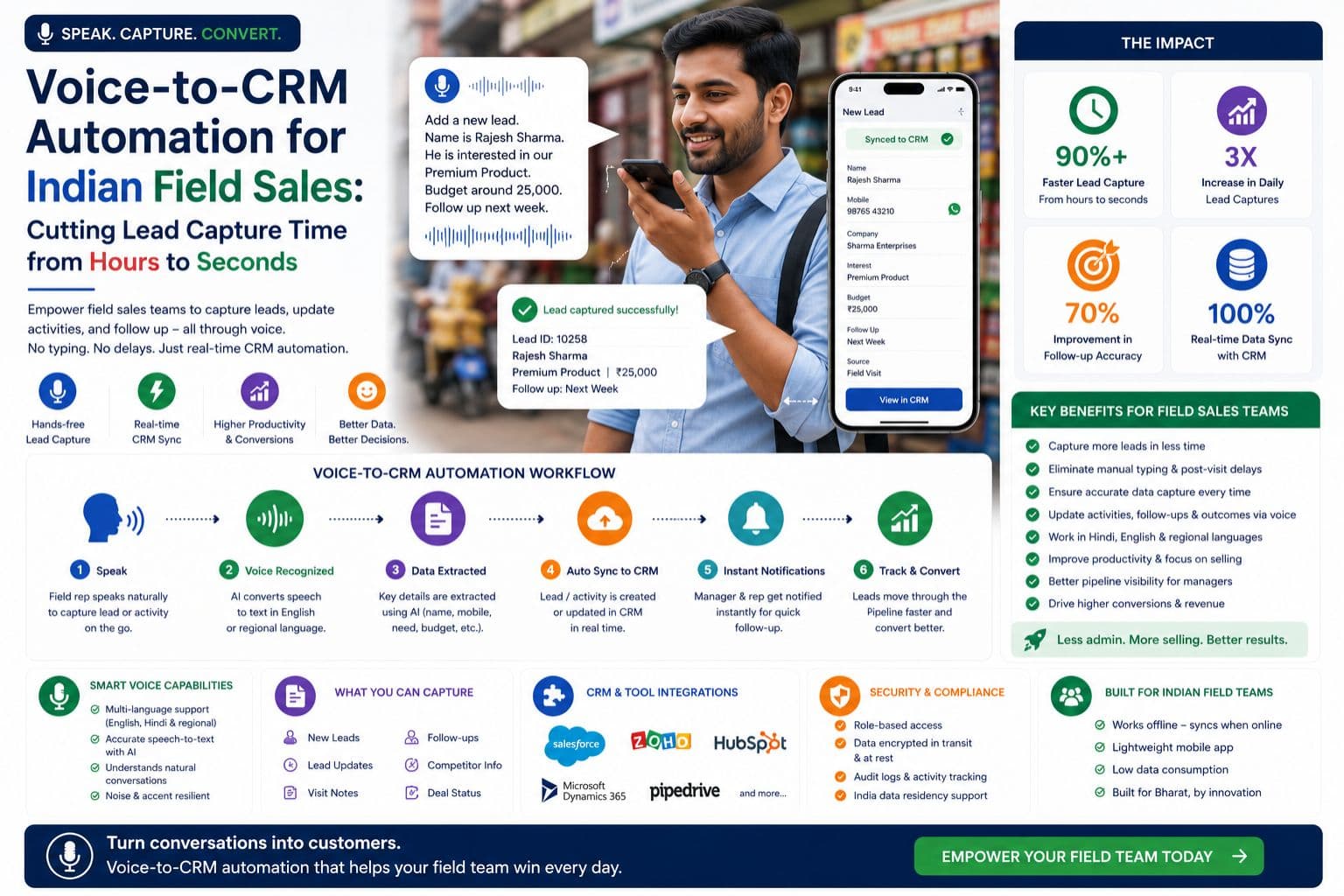
In Indian field sales, lead capture remains a primary bottleneck for many organizations. After a meeting with a distributor or retailer, sales agents often wait hours before entering details into the CRM, or worse, lose the information entirely. Voice-to-CRM automation for Indian field sales finally addresses this, letting agents speak a summary in their language and have it transcribed directly into a CRM field. One real-world observation is that agents in high-footfall markets like Delhi or Mumbai frequently skip CRM updates—typing a detailed note on a mobile takes too long when the network keeps dropping.
How Voice Input Changes Field Data Collection
This shift means the agent records a 30-second voice note after a customer visit. The system processes it through a local-language speech engine, structures the data, and pushes it to the CRM as a new lead. A non-obvious operational detail teams overlook is that the accent and background noise in Indian bazaars require specific training data for the speech model—generic English models fail consistently. Without this tuning, transcription accuracy drops below 70%, and agents just start rejecting the tool.
What Actually Happens When Voice-to-CRM Meets Indian Sales Workflows
In controlled pilots, teams saw lead entry times drop from 15 minutes of typing to under 30 seconds of speaking. But here's where it stops scaling: when the CRM backend has strict validation rules that reject partial data. For example, if the system requires a mandatory GST number field that the agent hasn't spoken, the voice pipeline either drops the lead or returns an error, which frustrates the agent. One common misunderstanding is that voice automation fixes the data quality issue; it doesn't. It shifts the problem from data entry speed to data completeness logic.
Common Risk: Over-Engineering the Voice Pipeline
Teams often assume that integrating a popular speech-to-text API solves the problem. The reality is that the CRM's API latency and offline synchronization logic create hidden delays. If the agent is in a low-connectivity zone, the voice file must queue locally and sync later—but many CRM platforms reject out-of-sequence data or treat it as duplicate entries. A boundary that becomes clear here is that voice-to-CRM works reliably only when the integration layer handles queue management and deduplication at the edge, not just at the server.
Need Bringmark's engineers to implement this for you?
Get a free 30-minute architecture & growth review tailored to your stack.
Decision Help: Choosing the Right Automation Path
For teams evaluating this, the decision hinges on two factors: the language diversity of the sales team and the CRM's existing integration architecture. If the team operates in Hindi, Tamil, and Telugu, the speech model must be multi-dialect fine-tuned. Additionally, the pipeline needs to handle a scale constraint—200 agents simultaneously sending voice notes can overwhelm a standard cloud gateway. A workflow dependency to note is that the CRM must accept a structured JSON payload from the voice processor, which many legacy Indian ERP systems do not support without middleware.
FAQ
q: How long does voice-to-CRM setup take for a 100-agent field team in India?
a: Typically 4 to 6 weeks, provided the CRM has an open API. The bulk of time goes into training the speech model on local accents and defining the data mapping rules.
q: What happens if a voice note contains sensitive customer financial information?
a: The system must apply an on-device or in-transit encryption layer plus a data masking routine before storing the transcription. This is a compliance and governance concept often missed during pilot phases.
q: Does voice automation work for teams using CRM platforms like Zoho or Salesforce in India?
a: Yes, but only if the integration uses the CRM's platform APIs for custom object creation, not standard web-to-lead forms. The latter strips contextual fields a voice pipeline provides.
q: Which CRM configuration reduces the risk of missed leads in voice-to-CRM automation?
a: A dual-write pattern that creates a draft lead locally on the agent's device immediately after transcription, then syncs to the cloud CRM when connectivity returns. This is where cross-discipline execution between mobile development and cloud service hardening matters, a principle we apply at bringmark. Without this, agents lose up to 15% of voice-captured leads during handover.
The core engineering, AI, cloud, and product development team at Bringmark Private Limited. We architect and operate production SaaS platforms, enterprise web applications, and resilient cloud infrastructure.